




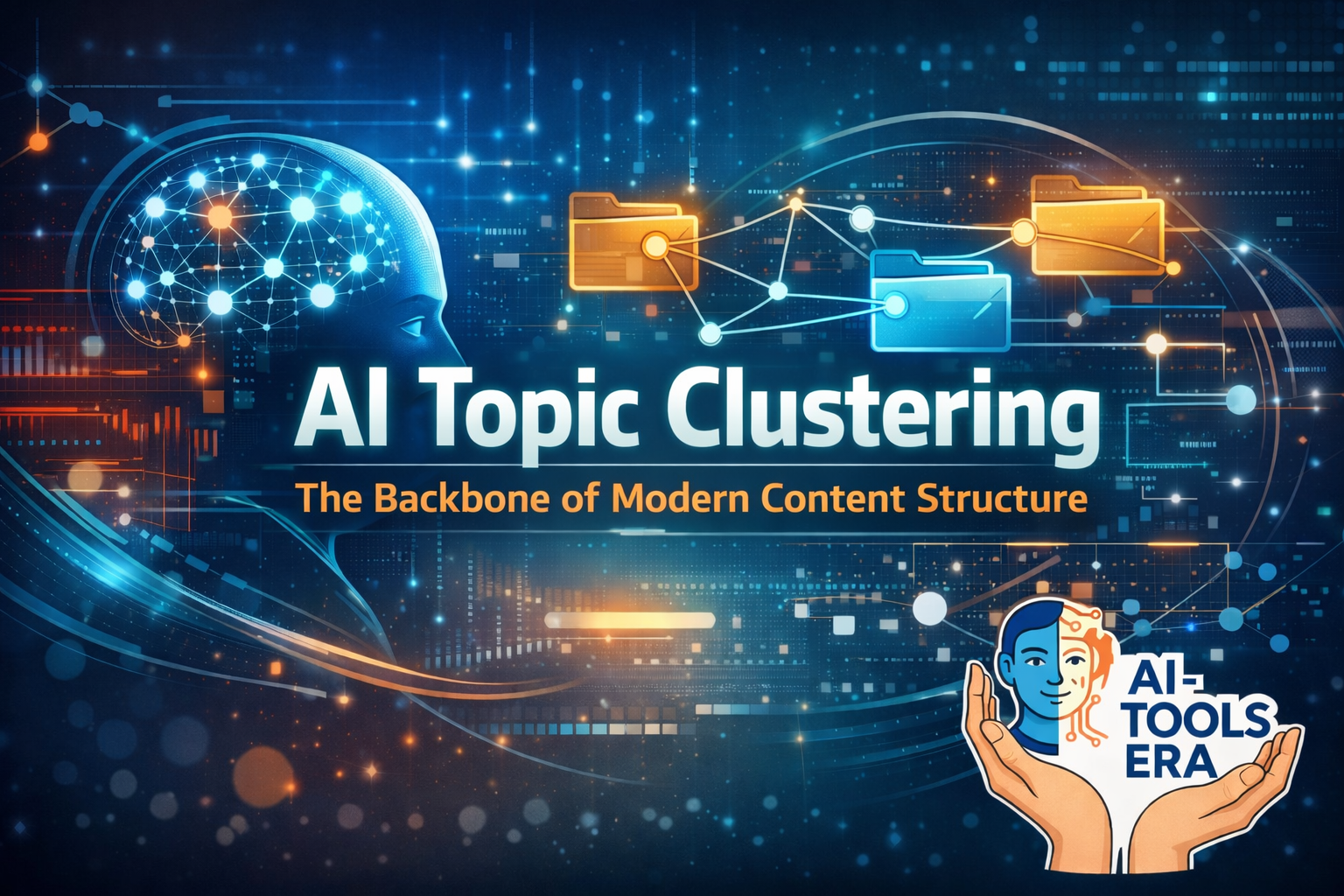
As search engines evolve toward understanding meaning rather than keywords, content structure has become more important than ever. One of the most critical systems behind this shift is AI Topic Clustering, a method of organizing content into interconnected groups based on semantic relationships.
Instead of creating isolated articles, modern content strategies focus on building clusters of related topics that collectively represent a subject. This approach improves clarity, authority, and search visibility.
In this guide, you will learn what AI Topic Clustering is, how it works, and how to implement it using a structured, evergreen framework.
What is AI Topic Clustering?
AI Topic Clustering is the process of grouping related content around a central theme using semantic relationships. It relies on artificial intelligence to identify connections between topics, entities, and user intent.
Rather than targeting individual keywords, Topic Clustering focuses on building a network of content that collectively covers a subject in depth.
This aligns closely with AI Semantic SEO, where meaning and context are prioritized over keyword repetition.
- Pillar Content: A comprehensive guide covering the main topic
- Cluster Content: Supporting articles that explore subtopics
- Internal Links: Connections between pillar and cluster pages
Together, these elements form a structured knowledge system that search engines can easily understand.
How AI Topic Clustering Works
AI Topic Clustering is powered by systems that analyze language, context, and relationships between concepts.
1. Data Collection
AI gathers large volumes of data from search queries, content, and user behavior to identify patterns.
2. Semantic Analysis
Natural language processing identifies relationships between words, phrases, and topics.
3. Entity Mapping
Concepts are grouped into entities and linked based on their contextual relevance.
4. Cluster Formation
Related topics are grouped into clusters centered around a main theme.
5. Continuous Optimization
Clusters evolve over time as new data and user behavior signals are analyzed.
Further Reading and References
Why Topic Clustering Matters
Topic Clustering is essential for building structured, scalable, and authoritative content systems.
- Improved SEO: Better alignment with search engine understanding
- Higher authority: Demonstrates expertise across a subject
- Enhanced user experience: Easy navigation across related topics
- Scalable structure: Simplifies content expansion
Without clustering, content remains fragmented and less effective.
Core Components of Topic Clustering
1. Pillar Content
A detailed, comprehensive article that serves as the main reference point for a topic.
2. Cluster Content
Supporting articles that explore specific aspects of the main topic in depth.
3. Internal Linking Structure
Links that connect all related articles, forming a semantic network.
4. Content Hierarchy
A logical structure that organizes topics from broad to specific.
5. Contextual Relevance
Ensuring all cluster content aligns with the central topic.
Relationship with Other AI Content Systems
AI Topic Clustering works alongside other foundational systems:
- AI Semantic SEO – Defines meaning and context
- AI Search Intent Modeling – Aligns clusters with user goals
- AI Knowledge Graphs – Connects entities across content
- AI Content Pipelines – Organizes content production workflows
Real-World Applications
Topic Clustering is used across various domains where structured content is essential.
- Content Platforms: Building knowledge hubs
- E-commerce: Organizing product categories and guides
- Education: Structuring learning materials
- Business Websites: Explaining services and solutions
In each case, clustering improves clarity, navigation, and authority.
Practical Framework for AI Topic Clustering
Step 1: Identify the Core Topic
Define the main subject that your content will cover.
Step 2: Research Subtopics
Identify all related concepts and questions connected to the main topic.
Step 3: Group into Clusters
Organize subtopics into logical groups based on relationships.
Step 4: Create Pillar Content
Develop a comprehensive article that covers the core topic.
Step 5: Develop Cluster Content
Write detailed articles for each subtopic.
Step 6: Build Internal Links
Connect pillar and cluster content using strategic linking.
Step 7: Optimize and Expand
Continuously update and expand clusters based on new insights.
Tools That Support Topic Clustering
While Topic Clustering is a conceptual strategy, certain tools can assist in organizing and analyzing content relationships.
These tools should enhance your strategy rather than replace structured thinking.
Key Insights
- Topic Clustering organizes content into structured systems
- It improves SEO through semantic relationships
- Internal linking is critical for cluster effectiveness
- Clusters build authority and scalability
- This approach aligns with modern AI-driven search systems
FAQ
What is Topic Clustering?
It is a method of organizing content into groups based on related topics.
How does it help SEO?
It improves structure, relevance, and authority, making content easier for search engines to understand.
What is a pillar page?
A pillar page is a comprehensive article that serves as the main topic reference.
How many cluster articles should I create?
There is no fixed number. Focus on covering all relevant subtopics.
Is Topic Clustering necessary?
Yes, it is essential for building scalable and effective content systems.
Conclusion
AI Topic Clustering is a foundational system for modern content strategy. It transforms isolated articles into interconnected knowledge networks, improving both user experience and search visibility.
When combined with AI Semantic SEO, it creates a powerful framework for building long-term authority.
To continue expanding your system, explore AI Search Intent Modeling and understand how user intent shapes content structure.